

+86 185 4892 6888

Water conservancy, focusing on water resource management and utilization, is indispensable for social stability, ecological balance and economic development. Its applications cover water supply regulation, disaster prevention, clean energy development and more. This article outlines its core application areas and practical values.
A core application of water conservancy is ensuring stable water supply for domestic, agricultural and industrial needs. With global population growth and urbanization, water security has become critical for social stability.
For domestic use, reservoirs, water intake structures and transmission pipelines form a complete supply system. Reservoirs store rainwater for dry seasons, regulating water distribution. For example, China’s Three Gorges Reservoir provides stable water for cities along the Yangtze River, meeting the daily needs of millions.
In agriculture, irrigation systems (canals, drip irrigation, sprinklers) are vital. They transport water to farmland, addressing uneven rainfall and ensuring crop growth. In arid regions, efficient irrigation boosts yields and guarantees food security, as seen in Egypt’s Nile Delta irrigation systems that have sustained agriculture for millennia.
For industry, water conservancy projects supply water for manufacturing, energy and chemical sectors. Stable water is essential for industrial operations. Meanwhile, water-saving technologies are promoted to improve efficiency and reduce waste.
Floods are highly destructive, and water conservancy engineering is key to flood control. By regulating water flow, storing and diverting floodwater, it minimizes flood impacts on lives and property.
Major flood control projects include reservoirs, dikes, diversion channels and storage areas. Reservoirs store excess floodwater to reduce downstream flow; dikes prevent inundation; diversion channels and storage areas relieve pressure on main rivers.
China’s Yellow River, prone to floods due to high sediment, has a comprehensive flood control system (dikes, reservoirs, storage areas), effectively reducing flood frequency and protecting lives and property in the basin.
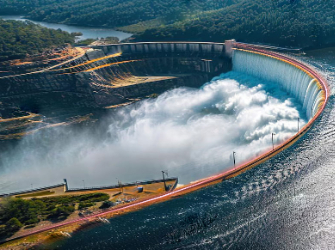
Hydropower, a clean renewable energy, relies on water conservancy engineering. Hydropower stations convert water’s potential and kinetic energy into electricity, providing stable, eco-friendly power.
Large hydropower stations like China’s Three Gorges and Brazil-Paraguay’s Itaipu have massive capacity, meeting electricity needs of cities and industries. Unlike thermal power, hydropower emits no greenhouse gases, supporting global energy transition and carbon neutrality.
Small and medium hydropower stations also benefit rural and remote areas, solving electricity access issues and boosting local economies.
With growing ecological awareness, ecological water conservancy has become a key direction. It coordinates human water use with ecological protection, ensuring ecological flow of rivers, lakes and wetlands.
Key applications include ecological water replenishment, river/lake remediation and wetland protection. Ecological replenishment diverts water to dry water bodies to restore functions. For example, China’s South-to-North Water Diversion Project not only alleviates northern water shortage but also replenishes ecological water for Haihe River and Baiyangdian Lake, improving the local ecological environment.
None
Hot Products
Latest Application